
When COVID-19 spread around the world in early 2020, every international sport was disrupted. Badminton was hit particularly hard because its professional circuit depends on players, coaches and officials travelling between countries almost every week. This article looks back at how the pandemic affected badminton – the suspended tour, the frozen rankings, the postponed Olympics and team championships – and at the changes in training, coaching and fan engagement that outlasted it.
The Tour Stops: March 2020
The 2020 All England Open in Birmingham, held in mid-March, was the last major event before the circuit shut down. Shortly afterwards, the BWF suspended its sanctioned tournaments. Events that had been scheduled for the following months – including the Swiss Open, India Open and Malaysia Open, among many others – were postponed and, in most cases, eventually cancelled for that year.
International badminton did not properly restart until the autumn. The Denmark Open in Odense in October 2020 was one of the first major tournaments to be held again, with strict health measures and a reduced field, since several Asian teams did not travel. In January 2021, the BWF staged three events in Bangkok in a “bubble” format – two Thailand Opens and the World Tour Finals – with players kept largely isolated between their hotel and the venue.
Team Championships and the World Championships
- Thomas and Uber Cup: the 2020 finals in Aarhus, Denmark, were postponed more than once and finally held in October 2021.
- Sudirman Cup: the 2021 edition was moved from China to Vantaa, Finland, and held in autumn 2021.
- World Championships: the 2021 BWF World Championships took place in Huelva, Spain, in December 2021.
Even after events resumed, the pandemic kept causing disruption. At the 2021 All England Open, the Indonesian team was withdrawn from the tournament after a passenger on their flight to the UK tested positive, which required the team to self-isolate. Throughout 2021, travel restrictions, quarantine rules and positive tests led to withdrawals and late changes to draws.
Rankings Frozen and Olympic Qualification Extended
The BWF World Ranking normally counts results from a rolling 52-week window. With no tournaments being played, that system could not work as normal, so the BWF froze the rankings as of 17 March 2020. When the rankings reopened on 2 February 2021, results already on the list were kept and new results were added, rather than old points dropping off after 52 weeks. The BWF only returned to a live 52-week ranking in stages: from August 2022 it removed four weeks of historical points per weekly publication, with the normal system back in place from 3 January 2023. Our guide to the BWF ranking system explains how the normal rolling system works.
The freeze had side effects. Established players were protected, but younger players in good form had no way to climb, and some players lost months of their best years. Olympic qualification, which is based on the rankings over a defined period, was also suspended and later extended to fit the new Olympic dates.
The Postponed Tokyo Olympics
In March 2020, the Tokyo 2020 Olympic Games were postponed by a year. They were held from 23 July to 8 August 2021, still under the name Tokyo 2020, with spectators barred from almost all venues. Badminton was played without crowds – unusual for a sport famous for noisy, passionate arenas – and athletes faced regular testing and strict restrictions on movement. For the wider history of the event, see our brief history of Olympic badminton.
The Paris 2024 Olympics, held with full crowds, were widely seen as a return to normal for the sport’s biggest stage.
Training Moved Home
When halls and training centres closed, players at every level had to improvise. Common adaptations included:
- Shadow footwork and swing practice in small spaces at home.
- Bodyweight strength and conditioning circuits, resistance bands and improvised weights.
- Skipping, running and cycling to maintain aerobic fitness.
- Wall drills and racket-handling exercises where space allowed.
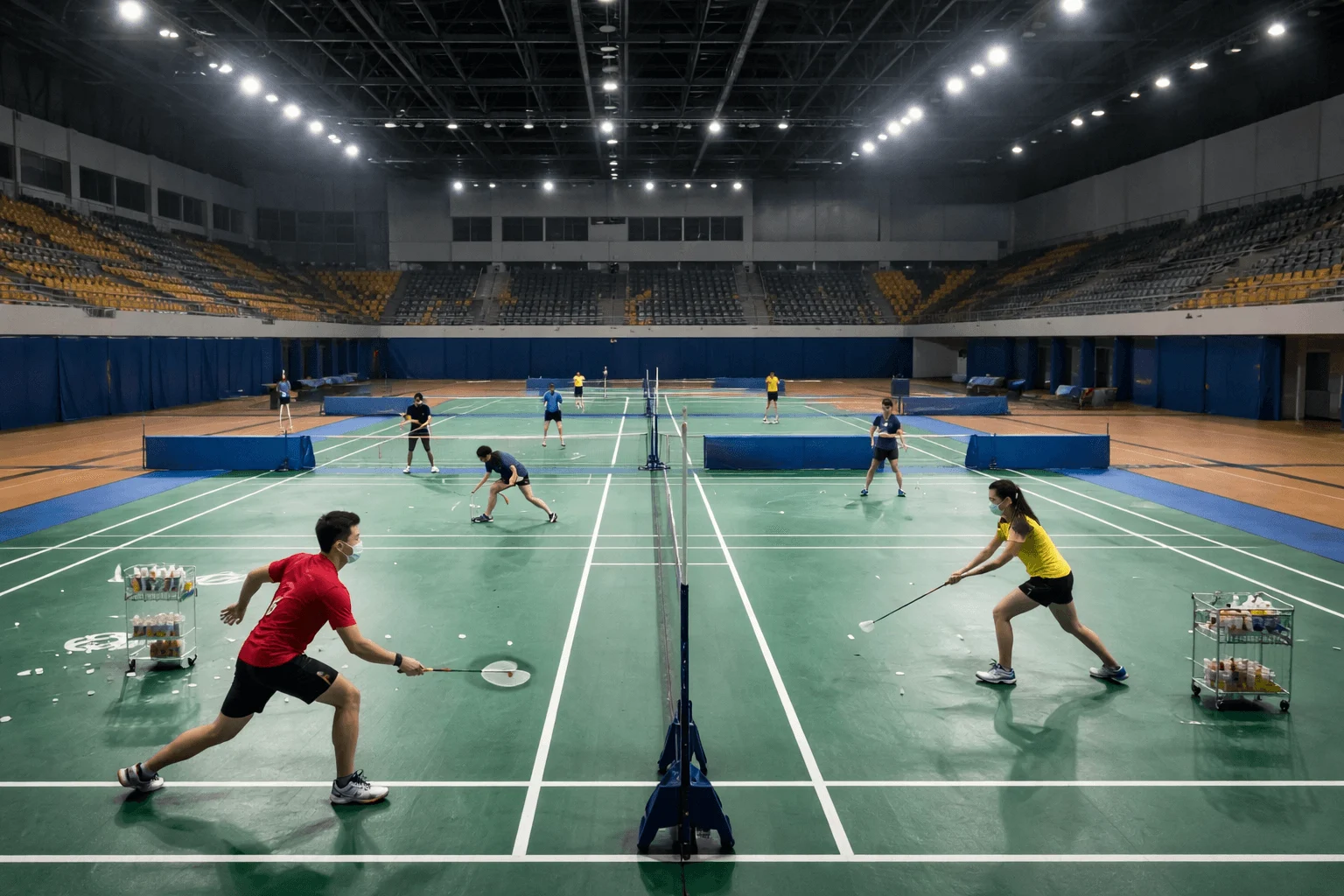
Some national teams and academies were able to keep training in controlled environments, but many players spent weeks or months without proper court time. Coaches used video calls and recorded clips to give feedback remotely, and many continued to use these methods once courts reopened.
Longer-Term Effects on Coaching
Remote video review and online sessions existed before the pandemic, but lockdowns made them far more common. Many coaches now combine in-person sessions with remote analysis, and the period also encouraged more attention to physical preparation, injury prevention and load management, since players returning after long breaks were at higher risk of injury. Our article on modern badminton coaching trends looks at these approaches in more detail.
Financial Pressure
Badminton players outside the very top earn a large share of their income from prize money, sponsorship and, in some countries, national federation or club support. With most tournaments cancelled for much of 2020, many players lost income, and some federations and clubs faced financial strain. At grassroots level, clubs and commercial centres lost revenue from court hire, coaching and local competitions during closures. The impact varied widely by country, depending on government support and how long facilities stayed closed.
Mental Health and Wellbeing
Isolation, uncertainty about when competition would return, quarantine during travel and long periods in tournament bubbles affected many athletes across sports. The pandemic helped bring mental health into more open discussion in elite sport generally, and badminton players were part of that conversation. Many teams have since paid more attention to psychological support.
Fans Moved Online
With no live events, fans turned to replays of classic matches, player social media and online content. When tournaments resumed behind closed doors, live streaming became the only way to watch. Online viewing was already important for badminton, but the pandemic reinforced it, and digital channels remain central to how many fans follow the sport.
What Lasted After COVID-19
- Wider use of remote and video-based coaching alongside in-person training.
- More attention to athlete welfare, load management and mental health.
- Greater reliance on online streaming and social media to reach fans.
- Experience in running events under strict health protocols.
The core of the sport did not change, and crowds have long since returned to arenas. But the pandemic tested badminton’s global structure and left lasting habits in how players train and how fans watch. For a look at where the sport could go next, see our article on the future of badminton.
Frequently Asked Questions
When were the Tokyo 2020 Olympics held?
From 23 July to 8 August 2021, after being postponed by a year. They kept the Tokyo 2020 name.
Was the 2020 All England Open cancelled?
No. It went ahead in March 2020 and was the last major event before the BWF suspended its tour.
Did the BWF freeze its rankings?
Yes. Rankings were frozen as of 17 March 2020, reopened in February 2021 with historical points retained, and returned to a normal 52-week ranking in January 2023.