
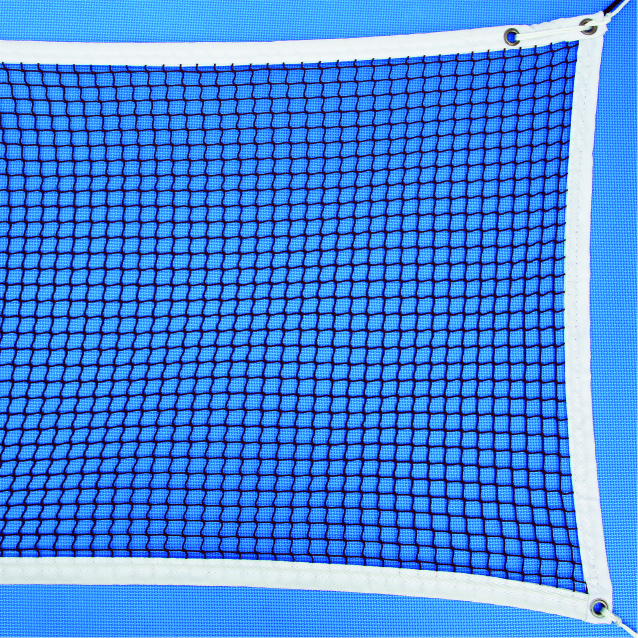
Whether you are putting up a net in the garden or equipping a sports hall with several courts, the net decides more than it seems. A net at the wrong height changes every serve and net shot. A sagging net makes rallies feel random, and a cheap net that frays after a season costs more in the end. This guide explains the official net specifications, the features to check before you buy, and how needs differ between home practice and club use.
Official Badminton Net Specifications
The Laws of Badminton published by the Badminton World Federation (BWF) set out the net and post dimensions. In summary:
| Element | Specification |
|---|---|
| Net height at the centre | 1.524 m (5 ft) from the floor to the top of the net |
| Net height at the posts | 1.55 m (5 ft 1 in) over the doubles side lines |
| Net depth (top to bottom) | 760 mm |
| Net width | At least 6.1 m (20 ft) |
| Mesh | Fine cord of dark colour and even thickness, with a mesh of 15–20 mm |
| Top edge | Edged with a 75 mm white tape, doubled over a cord or cable running through it |
| Posts | 1.55 m high, placed on the doubles side lines |
The posts stand on the doubles side lines for both singles and doubles. There should be no gap between the ends of the net and the posts. For the full court layout, see our badminton court dimensions guide.
Club and sports-hall nets are often sold slightly wider than 6.1 m, for example around 6.7 m, so that they reach fully across to posts with tensioning fittings. Always check the net width against your post spacing.
Key Features to Check Before Buying
1. Size and fit to your posts
A net is only part of a system. It needs posts, a tensioning method and either floor sockets, weighted bases or ground stakes. Before buying, measure the distance between your posts (or where they will go) and check how the net attaches: tie cords, a steel top cable, or a ratchet on the post.
2. Top cord or cable
The top edge carries all the tension. Club nets usually have a steel cable or strong cord through the white tape so the net stays taut and level. Cheap nets often use thin string, which stretches and lets the net sag in the middle.
3. Material and durability
Nets are typically made from knotted or knotless polyethylene, polypropylene, nylon or polyester cord. For indoor club use, look for thicker cord and reinforced side bindings. For outdoor use, UV-resistant material and rust-resistant fittings matter, because sunlight and rain degrade cheap nets quickly.
4. Mesh size and colour
Regulation mesh is 15–20 mm in a dark colour. Darker mesh makes the white shuttle easier to see against it. Garden nets with wider mesh work for casual play but feel less like the real thing.
5. Ease of setup and storage
For home use, look for a portable set with lightweight poles, a carry bag and simple tensioning. For clubs, check how quickly nets can be put up and taken down, because hall time is often limited.
6. Adjustable height
Portable systems often allow lower heights for children or for other games such as volleyball. If you buy one, mark or measure the correct badminton height every time you set it up.
Examples of Club and Practice Nets
The nets below are examples of types sold for club and home use. Specifications and availability change and vary by country, so check the seller’s current details, particularly width, mesh and top-cord construction, against the table above.
- Club and sports-hall nets from specialist suppliers such as Harrod Sport, Zoft and Vinex are built for regular use, typically with regulation mesh, a white top tape and a strong top cord or cable.
- School nets are designed to survive heavy, frequent use and are often sold alongside matching posts.
- Budget nets sold online and in general sports shops are fine for the garden, but often have thinner cord and wider mesh. Check the width and plan to replace the tie cords with stronger rope.
Home Setup vs Club Use
For home practice
- A portable net and pole set is the practical choice for gardens, driveways and garages.
- Check that you have room for at least a short court. A full doubles court is 13.4 m long and 6.1 m wide, plus clearance around it.
- Indoor garage or hall practice needs enough ceiling height for high serves and clears.
- Outdoors, wind is the biggest problem. Our guide to indoor vs outdoor badminton gear covers shuttles and other gear that cope better outside.
- Bring the net in after use; sun and rain shorten its life considerably.
Many beginner sets include a net, rackets and shuttles. Our guide to budget badminton kits for beginners explains what to expect from those sets.
For club or frequent use
- Choose full regulation size, dark mesh, a strong top cable and reinforced bindings.
- Make sure the net matches the hall’s posts and tensioning system, or buy posts and net together.
- Weighted or floor-socket posts keep the net stable; lightweight posts tip when players brush the net.
- Paying more for durability usually saves money and setup frustration over several seasons.
How to Set Up and Tension a Net
- Position the posts on the doubles side lines, directly opposite each other.
- Attach the top cord or cable and tension it until the net is level and taut.
- Measure the height at the centre (1.524 m) and at the posts (1.55 m). A slight dip in the middle is normal; more than that means you need more tension.
- Tie the side edges to the posts so there is no gap between net and post.
- Check the bottom edge; it should hang evenly and not be pulled down hard, which distorts the mesh.
Care and Maintenance
- After outdoor use, let the net dry before storing it to prevent mildew.
- Release the tension when the net is not in use for long periods; constant tension stretches the cord.
- Replace frayed tie cords and worn top tapes before they fail mid-session.
- Store the net rolled or loosely folded in a bag, away from sunlight and sharp objects.
- Check posts, bases and fittings regularly. A net can look fine while loose posts let it sag.
For other kit to have on hand at practice, see our checklist of essential badminton accessories.
Frequently Asked Questions
How high should a badminton net be?
1.524 m (5 ft) at the centre and 1.55 m (5 ft 1 in) at the posts, which stand on the doubles side lines.
Is a singles net different from a doubles net?
No. The same net and post positions are used for both. Only the court lines in play change.
Can I use a volleyball or tennis net for badminton?
For casual play, yes, if you can set it to the right height. A tennis net is much lower at the centre, so it needs raising. Volleyball nets are often wider and deeper than badminton nets.