
If you have been borrowing a friend’s racket or using an old one from the cupboard and want to take badminton more seriously, buying your first proper racket is an exciting step. It can also be confusing. Shops and websites list hundreds of options, and the descriptions are full of terms like 4U, G5, head-heavy and stiff shaft.
This guide is written for that first purchase. It explains which specifications matter for a beginner, what to ignore for now, how much to spend and which mistakes to avoid. For a broader explanation of racket specifications at every level, see our badminton racket buyer’s guide.
Why Your First Racket Choice Matters
A first racket will not turn you into a strong player overnight, but the wrong one can slow your progress and even contribute to injury. Common problems when beginners choose badly:
- Too heavy or too head-heavy: the arm tires quickly, technique suffers and the elbow and shoulder take extra strain.
- Too stiff: clears fall short because a beginner’s swing is not fast enough to bend a stiff shaft, which encourages muscling the shot.
- Too expensive: you pay for features designed for advanced swings.
- Too cheap: very basic rackets are heavy, bend easily and may not last.
The good news is that finding a suitable beginner racket is not complicated once you know what to look for.
The 5 Key Factors for a First Racket
1. Weight: start light
Racket weight is usually printed as a “U” class, where a higher number means lighter. The figures refer to the unstrung frame:
- 3U: about 85–89 g
- 4U: about 80–84 g
- 5U: about 75–79 g
For most adult beginners, 4U or 5U is the right choice. A lighter racket is faster to swing and recover, reduces arm fatigue and makes it easier to learn correct technique. Strong adults who have played other racket sports may be comfortable with 3U, but there is no advantage in starting heavy.
2. Balance: even or slightly head-light
- Head-heavy: more weight in the frame for power on smashes; slower to handle and more demanding on the arm. Usually not the best choice for a first racket.
- Even balance: a versatile middle ground. Ideal if you do not yet know your style.
- Head-light: quick and manoeuvrable, good for defence, net play and doubles.
An even-balanced or slightly head-light racket lets you try all kinds of shots. You can buy a more specialised racket later when your style develops.
3. Shaft flexibility: choose flexible
The shaft bends during the swing and straightens just before contact. A flexible shaft stores and returns energy even with a slower swing, so beginners get more length on clears with less effort. Medium flex also works for athletic beginners. Stiff shafts only perform well with fast, well-timed swings and are not recommended for a first racket.
4. Grip size: easy to overlook
Grip size is printed after the weight class, for example “4UG5”. In Yonex and Victor sizing, a higher G number means a thinner handle, so G5 is thinner than G4. Other brands use their own labels.
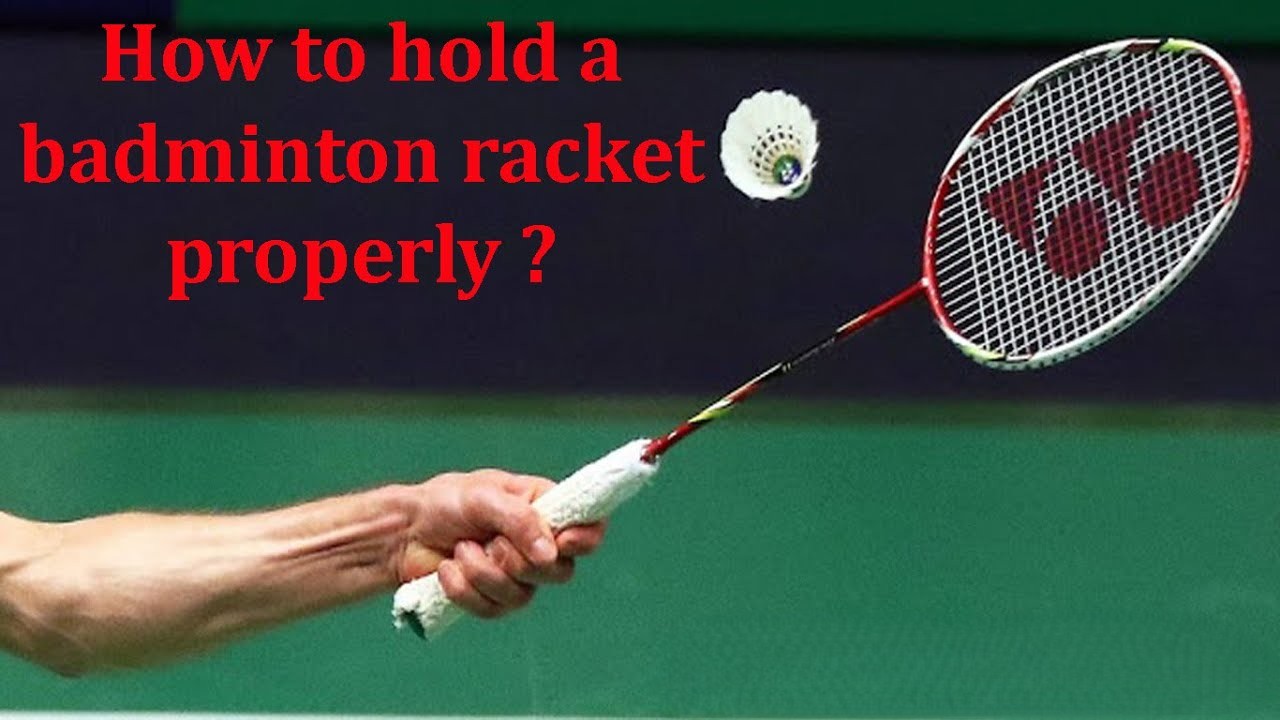
To check fit, hold the racket in a relaxed forehand grip. A common rule of thumb is that your fingers should wrap around comfortably, with the tips of your middle and ring fingers lightly touching or close to the base of your thumb. If you have to squeeze hard to stop the racket turning, or your fingertips dig into your palm, the size is wrong.
It is easy to make a handle thicker with an overgrip but impossible to make it thinner, so if in doubt choose the thinner size. If you are unsure how to hold the racket, read our guide to holding a badminton racket properly before you test grips in a shop.
5. Material: graphite over aluminium
- Aluminium or steel rackets: inexpensive and tough, fine for garden games, but heavier and less responsive. They limit progress if you play regularly.
- Graphite (carbon fibre) rackets: lighter and more responsive. Almost every racket designed for club play is graphite.
If you plan to play regularly, a graphite racket from an established brand is worth the extra cost over a basic aluminium one.
Budget Guide: How Much Should You Spend?
Prices vary by country, so use these bands as a rough guide:
Lowest price band: casual play only
Mostly aluminium or basic composite rackets and family sets. Fine for occasional garden games, not for learning properly.
Entry-level graphite: the beginner sweet spot
Light, flexible graphite rackets from brands such as Yonex, Li-Ning, Victor and Apacs. This is where most beginners should look. Our guide to the best badminton rackets under $50 covers this band in detail.
Mid-range: if you plan to play long-term
Better materials and more specific balance and flex options. Not necessary for absolute beginners, but sensible if you already play several times a week.
Flagship: not needed yet
Tournament-grade rackets are usually stiff and demanding. They offer little benefit until your technique is advanced.
Types of Racket to Look For
Rather than chasing one specific model, use this profile when shopping: a graphite racket, 4U or 5U, even or slightly head-light balance, flexible shaft, and a grip size that fits your hand. Most major brands have entry series built around this profile. Examples include the entry versions of Yonex’s Astrox and Nanoflare lines (such as the graphite Astrox 01 and Nanoflare 001 series), Nanoray models in markets where they are still sold, and graphite Muscle Power models (the cheapest Muscle Power rackets use aluminium frames), as well as entry models from Li-Ning, Victor and Apacs. Model names and specifications change regularly, so check the specification printed on the racket or the manufacturer’s website before buying.
Common Mistakes Beginners Make
Buying on looks
A racket covered in “power” graphics may well be a stiff, head-heavy model meant for advanced players. Focus on the specifications.
Going too cheap
A very cheap aluminium racket may seem good value, but you will outgrow it quickly if you play regularly.
Buying a professional’s racket
The flagship models used by top professionals are designed for elite swing speeds. Buy for your current level, not your aspirations.
Worrying about string tension too early
Factory-strung rackets come with a durable string at a moderate tension, which is fine for a beginner. Once the strings break or lose tension, our string tension guide explains how to choose.
Not trying before buying
If possible, hold and swing the racket in a shop, or borrow a similar model from a club-mate. If buying online, check the return policy.
Quick Decision Guide
- Playing occasionally with friends and family? An inexpensive racket or set is enough.
- Planning to play regularly or join a club? Buy an entry-level graphite racket in 4U or 5U with a flexible shaft.
- Not sure of your style? Choose even balance.
- Already love attacking? Slightly head-heavy is fine, but keep the shaft flexible.
- Mostly play doubles or prefer defence? Choose head-light.
- Buying for a child? See our guide to rackets for kids and teen players, as length and grip size matter more.
What Else Do You Need?
Essential:
- Shuttlecocks: nylon shuttles are durable and economical for practice; feather shuttles are used in clubs and competition.
- Indoor court shoes: proper non-marking court shoes with good grip and lateral support help prevent ankle injuries. Running shoes are not designed for sideways movement.
Useful:
- Racket cover or bag to protect the frame.
- Overgrips to keep the handle fresh and adjust its thickness.
- Wristband or towel for sweat.
How to Take Care of Your First Racket
Do
- Keep it in a cover when not in use.
- Keep it away from extreme heat, such as a car boot in summer.
- Wipe the grip after playing and replace the overgrip when it becomes slippery.
- Restring when the strings break or the string bed feels dead.
Don’t
- Scrape the floor or hit walls and net posts.
- String above the maximum tension printed on the frame.
- Pack it next to hard objects such as metal water bottles or keys.
A well-cared-for graphite racket can last for years. Most breakages are caused by clashes, floor strikes or over-tensioned strings rather than by normal play.
When to Upgrade to Your Second Racket
It is time to consider an upgrade when:
- You have been playing regularly for several months or more.
- You have developed a clear style: attacker, defender or all-rounder.
- Your technique has improved and your swing is noticeably faster.
- You feel your current racket limits a specific part of your game.
There is no rush. Your first racket is teaching you the fundamentals.
Frequently Asked Questions
Can I use a tennis or squash racket for badminton?
No. They are much heavier and designed for a different ball and swing. Badminton requires a light racket for fast wrist and forearm action.
Should I buy two rackets?
Not at first. Spend the money on shuttles, court time or coaching instead. A second racket becomes useful once you play often enough that a broken string would cost you a session.
Is a branded racket always better?
Established brands generally have more consistent quality control. Very cheap unbranded rackets may save money initially but are often heavier and less durable.
Can I share a racket with my partner?
You can if you have similar hand sizes and levels, but a racket that suits one player may not suit another, especially in grip size.
How do I know if my racket is too heavy?
If your arm or shoulder feels sore after an ordinary session, or you cannot swing quickly at the end of a game, it may be too heavy or too head-heavy.
Should I buy online or in a shop?
Both work. Shops let you hold the racket and check the grip; online stores often have wider choice. Buy from authorised sellers, because popular models are often counterfeited.
Your Action Plan
- Decide how often you will play and set a budget.
- Shortlist graphite rackets with the beginner profile above.
- Check the grip size against your hand.
- Read reviews from reputable badminton sources and check the seller is authorised.
- Buy, get on court, and focus on technique. The best racket is the one that lets you play comfortably and often.