
Most players notice their stamina only when it runs out: the lunge to the net arrives a step late, the clear lands short, and the last few points of a close game feel like hard work. Badminton stamina is not the same as being able to jog for an hour. It is the ability to repeat short, intense efforts with brief rests, and to keep your footwork and decisions sharp while you do it.
This guide explains what badminton stamina really is, how to train it on and off court, and how to progress over six to eight weeks. It sits within our wider fitness series; if you want the big picture first, start with the best exercises for badminton players.
What Stamina Means in Badminton
A badminton match is a series of short rallies separated by brief pauses between points and longer breaks at the interval and between games. That structure places two demands on your body:
- An aerobic base. Your aerobic system does much of the work of recovering between rallies. A better base means your breathing and heart rate settle faster, so you start the next point fresher.
- Repeated high-intensity capacity. Within rallies, you need to sprint, lunge and jump again and again without slowing down.
Good stamina training builds both. It also improves something less obvious: when you are less fatigued, your technique and concentration hold up better late in a match.
Step 1: Build an Aerobic Base
If you are new to training or returning after a break, spend the first two to three weeks building a base with steady, moderate activity. You should be able to talk in short sentences while you do it.
- Jogging: 20 to 30 minutes, two or three times a week.
- Cycling or swimming: lower-impact options that are useful if your knees or ankles are sore.
- Skipping: start with short sets (for example 10 rounds of 30 seconds on, 30 seconds off) and build up. Skipping also trains the calves and foot rhythm you use on court.
Steady work is a foundation, not the whole plan. Once you can comfortably manage 30 minutes of continuous activity, start shifting toward intervals.
Step 2: Add Badminton-Style Intervals
Interval training alternates hard work with rest. For badminton, keep the work periods short and the movements specific.
Shadow footwork intervals
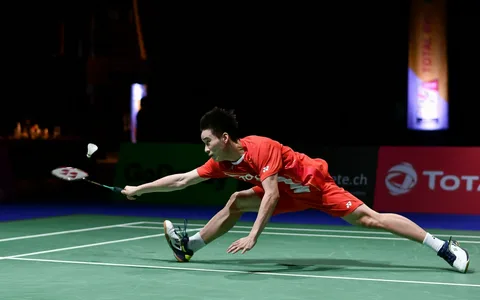
Move from your base position to the six corners of the court (two net corners, two mid-court sides, two rear corners) as if playing shots, returning to base each time.
- Beginner: 8 rounds of 15 seconds work, 45 seconds rest.
- Intermediate: 10 rounds of 20 seconds work, 30 seconds rest.
- Advanced: 12 to 15 rounds of 30 seconds work, 30 seconds rest, or 2 to 3 blocks with a longer break between blocks.
Keep the quality high. If your movement becomes sloppy, extend the rest rather than forcing more repetitions.
Multi-shuttle feeding
A partner or coach feeds shuttles rapidly to different areas, and you play each one. This combines conditioning with real strokes. Sets of 15 to 30 shuttles with rest equal to or longer than the work time are a good place to start.
Off-court intervals
When you cannot get a court, try shuttle runs between two lines 5 to 10 metres apart, or bike intervals of 20 to 30 seconds hard with 40 to 60 seconds easy. Change-of-direction work is covered in more detail in our agility drills for badminton.
Step 3: Support Stamina with Strength
Stronger legs make each lunge and push-off cost a smaller share of your maximum effort, so you tire less quickly. Two short strength sessions a week focused on split squats, lunges, calf raises and core work are enough for most players. Our guide to strength training exercises for badminton players shows how to perform and progress each one.
Step 4: Recover So You Can Adapt
Fitness improves during recovery, not during the session itself. Three habits matter most:
- Sleep. Most adults need around seven to nine hours. Consistently short sleep makes hard sessions feel harder.
- Fuelling. Carbohydrate is the main fuel for repeated sprints, and protein supports repair. Our badminton diet plan covers practical meals around training and matches.
- Easy days. Not every session should be hard. Light cycling, walking or mobility work on recovery days helps you train well the next day.
Breathing also deserves attention. Between rallies, use the time to take slow breaths through the nose and out through the mouth, rather than rushing to the next serve. It helps you settle and refocus.
Sample Six-Week Stamina Progression
This progression assumes two court sessions a week alongside the training below.
| Weeks | Session A | Session B | Session C |
|---|---|---|---|
| 1 to 2 | 25 min steady jog or bike | Strength (legs and core) | Skipping 10 x 30s on / 30s off |
| 3 to 4 | Shadow footwork 10 x 20s on / 40s off | Strength (legs and core) | 20 min steady plus 6 short shuttle runs |
| 5 to 6 | Shadow footwork 12 x 25s on / 30s off | Strength (power focus) | Multi-shuttle feeding, 5 sets of 20 shuttles |
Keep at least one full rest day a week. If you have a tournament coming up, reduce the volume in the final week; our article on training for competitive badminton tournaments explains how to taper.
Common Stamina Training Mistakes
- Only doing long runs. They build a base but do not prepare you for repeated sprints and sharp stops.
- Going flat out every session. Without easy days, fatigue builds and progress stalls.
- Letting technique fall apart. Conditioning drills done with poor footwork can reinforce bad habits.
- Increasing too quickly. Add work gradually; a sudden jump in training load is a common cause of injury.
- Ignoring sleep and food. They limit how much training you can absorb.
Frequently Asked Questions
How long does it take to improve badminton stamina?
Most players feel a difference within three to six weeks of consistent training, with larger gains over several months.
Is skipping good for badminton stamina?
Yes. Skipping builds aerobic fitness, calf endurance and foot rhythm, and it needs very little space or equipment.
Should I train stamina on the same day as playing?
You can, but do short conditioning blocks after your skill work, not before, so fatigue does not spoil your technique practice.
Why do I get tired quickly even though I play often?
Inefficient footwork, poor recovery between points, and a low aerobic base are common causes. Working on all three usually helps more than simply playing more games.