

The smash is badminton’s main finishing shot: a steep, fast overhead hit aimed downward into your opponent’s court. Most club players believe a better smash comes from swinging harder. In practice, the biggest gains come from getting behind the shuttle earlier, using the whole body in sequence, relaxing the grip until contact and choosing a smarter target. This guide covers the standing smash hit from the ground: the mechanics, the placement, the main variations and the drills that improve it. If you already have a solid smash and want to add height and angle by leaving the ground, the separate guide to the badminton jump smash covers takeoff, timing and safe landing.
Where Smash Power Really Comes From
A powerful smash is the result of a kinetic chain: force starts in the legs, passes through the hips and trunk, then the shoulder, elbow and forearm, and finally the racket head. Each link speeds up the next. If one link is missing, for example if you hit square-on without rotating, the arm has to do all the work and the shot is both weaker and harder on the shoulder.
The Sequence, Step by Step
- Turn side-on. As soon as you see a lift, turn so your non-racket shoulder points toward the net. Right-handers have the right foot back.
- Load the back leg. Your weight sits on the racket-side foot, knee slightly bent.
- Raise both arms. The non-racket arm points up at the shuttle for balance and tracking; the racket arm is bent with the elbow roughly at shoulder height and the racket head dropped behind you.
- Rotate the hips, then the shoulders. Push off the back leg and let the hips turn first, with the chest following.
- Lead with the elbow. The elbow comes forward and up before the racket head, like a throwing action.
- Pronate the forearm at contact. Most of the final racket-head speed comes from the forearm rotating inward (pronation), not from a big flick of the wrist. The wrist stays loose and follows the forearm.
- Follow through down and across. The racket finishes across your body on the non-racket side, and the back foot comes through to the front so you are ready to move forward.
Grip Pressure
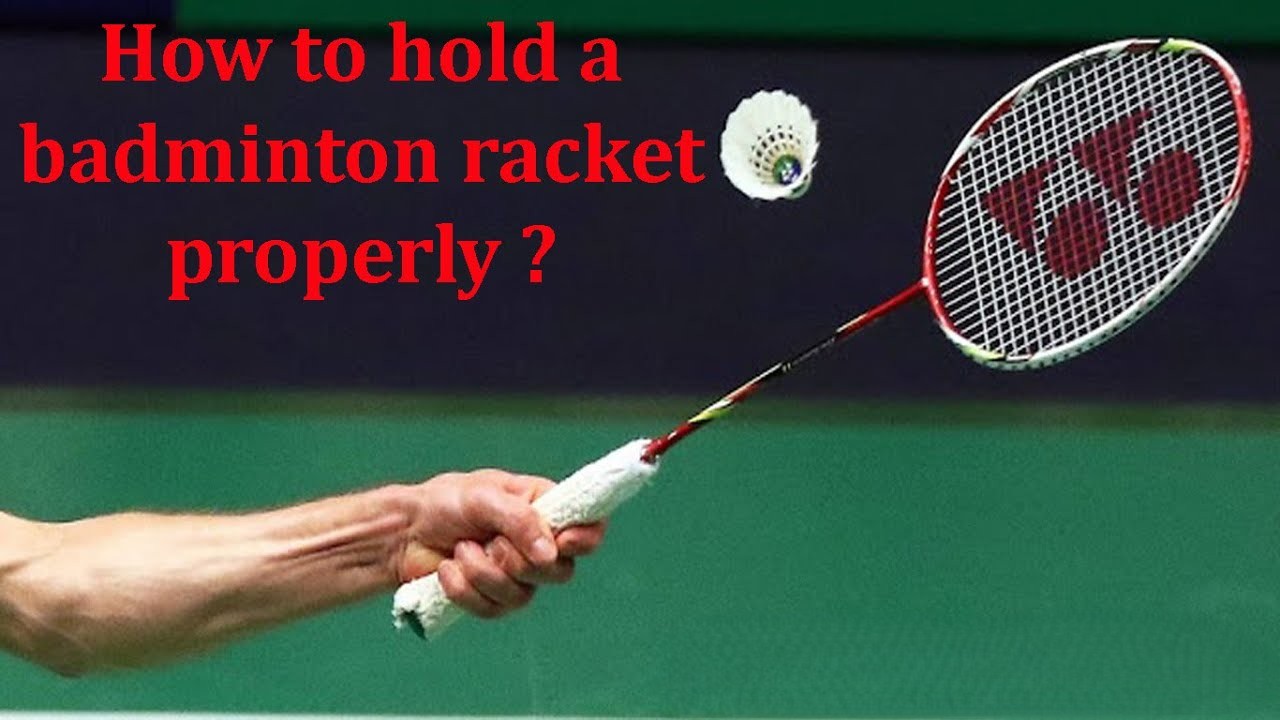
Use a forehand (handshake) grip and hold it loosely during the preparation, with the fingers rather than the palm in charge. Squeeze firmly only at the moment of impact, then relax again. A tight grip throughout the swing locks the forearm and slows the racket head. If you are unsure whether your grip is correct, the guide to badminton grip types explains the forehand grip and its variations in detail.
Contact Point: Height and Position
Where you meet the shuttle matters as much as how fast you swing. Aim to strike it:
- In front of your body, slightly ahead of your racket shoulder. Contact behind your head sends the shuttle flat or upward.
- With the arm close to full extension, so you use the highest point you can reach comfortably.
- Early in its fall, rather than waiting for it to drop. A higher contact point gives a steeper angle over the net.
The practical fix for most poor smashes is footwork: move back early so the shuttle is falling in front of you rather than above or behind you. A smash hit from a late, cramped position usually works better as a clear or a drop.
Placement Beats Pure Speed
A medium-paced smash to the right place often wins more points than a full-power smash straight at the opponent’s racket. Useful targets include:
- The body, especially the racket-side hip or shoulder. The opponent has to decide between forehand and backhand and has little room to swing.
- The sidelines. A straight smash down the line forces a stretch and opens the cross-court.
- The gap between doubles partners. A smash down the middle can cause hesitation over who takes it.
Sending the shuttle exactly where you intend depends on racket-face angle and contact timing, which the guide on how to control shuttle direction covers shot by shot.
Smash Variations Worth Learning
| Variation | What it is | When to use it |
|---|---|---|
| Full smash | Maximum racket-head speed, steep angle | From a good position on a short or mid-height lift |
| Half smash | Less pace, steeper and shorter landing | From the back of the court, or when you need to keep your balance for the next shot |
| Stick smash | Short, compact swing with a sharp stop, often from mid-court | Fast doubles exchanges where there is no time for a full swing |
| Slice (cut) smash | Racket face brushes across the shuttle to change angle and pace | To disguise direction or take pace off without changing preparation |
Because the half smash and slice smash share the same preparation as the full smash, they also set up deception. The drop shot technique guide explains how to use that identical preparation to hold your opponent back before playing short.
Smashing in Singles vs Doubles
In singles, every full smash takes energy and leaves the front court open while you recover. Smash when the lift is short or the opponent is off balance, and be ready to move quickly toward the centre. Many singles points are set up by a steep half smash followed by a net shot.
In doubles, the attacking pair plays front and back, so the smasher can keep hitting down while the partner covers the net. Repeated, steep smashes to the body or the middle are standard. Smash speed matters, but the angle and the follow-up from your partner usually decide the rally.
Common Smash Mistakes and Fixes
- Hitting square-on. Without turning side-on you lose hip and shoulder rotation. Fix: rehearse the turn in shadow footwork before every smash session.
- Letting the shuttle get behind you. The smash goes flat or long. Fix: move back earlier and make contact in front.
- Dropping the elbow. A low elbow shortens the lever and strains the shoulder. Fix: keep the elbow at or above shoulder height in preparation.
- Squeezing the grip throughout. Fix: practise swinging with a deliberately loose grip and tightening only at contact.
- No recovery. Admiring the smash leaves you stranded. Fix: let the back foot come through and push back toward base straight away.
- Smashing from a bad position. Fix: if you are late or off balance, play a clear or drop instead.
Drills to Improve Your Smash
1. Shadow Smash Sequence
Without a shuttle, move from base to the rear forehand corner, turn, swing and recover. Do 3 sets of 10, focusing on the order of hips, shoulder, elbow, forearm. This builds the chain before you add a shuttle.
2. Feed-and-Smash Targets
A partner lifts to your forehand rear court. Place two targets, one near each doubles sideline at mid-court. Hit 10 smashes to each, counting how many land within a racket length of the target. Increase difficulty by having the partner call the target as the lift goes up.
3. Smash, Net, Recover
The feeder lifts, you smash, the feeder blocks short, you move forward and play a net shot, then recover. This trains the follow-up that makes a smash effective in real rallies.
4. Half-Smash Control
From the back of the court, alternate full and half smashes, aiming the half smash to land just past the short service line. This teaches control of pace without changing your preparation.
Wall smashing is sometimes suggested, but the rebound is too quick to rehearse a full overhead action. A wall is better for defence and drive practice than for smash technique.
Strength, Mobility and Equipment
Smash power benefits from leg strength, trunk rotation and shoulder stability more than from big arm muscles. Squats, lunges, medicine-ball rotational throws and band work for the rotator cuff are useful foundations; the guide to strength training exercises for badminton players has a fuller programme. Equipment plays a smaller role than technique, but string tension does change feel: very high tension needs precise, fast contact to work well. The string tension guide explains the trade-offs.
Frequently Asked Questions
Should I snap my wrist to smash harder?
Most coaches now teach forearm pronation as the main source of racket-head speed, with a relaxed wrist following the forearm. Forcing a big wrist flick tends to reduce control and can strain the wrist.
Why does my smash go long or flat?
Usually because the contact point is behind or directly above your head. Move back earlier so you strike the shuttle in front of your racket shoulder.
Do I need to jump to smash well?
No. A well-placed standing smash is effective at every level. Jumping adds height and angle once the ground-based technique is consistent.
How often should I smash in a singles match?
Smash when the lift gives you a clear chance and you can recover. Constant full smashes drain energy and leave the front court open.