

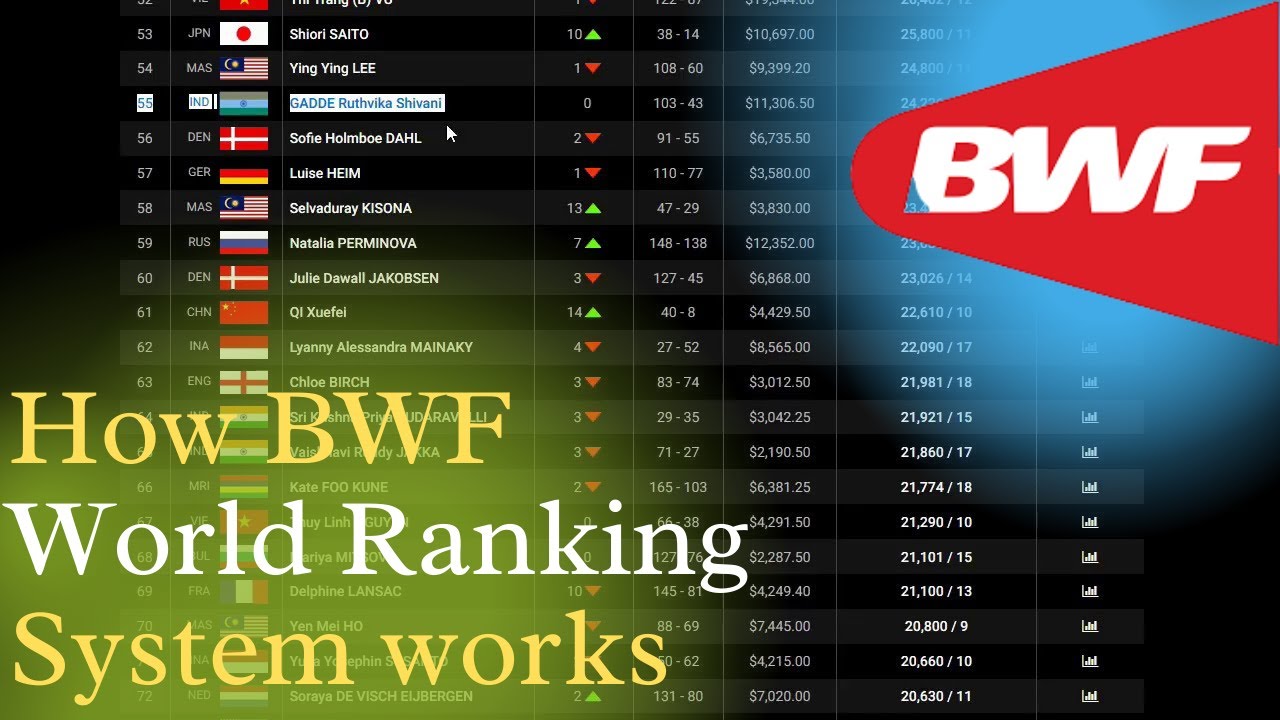
The world ranking of a badminton player — singles or doubles — under Badminton World Federation (BWF) is not just about how many matches you win. It’s a structured system based on tournament performance frequency kind of tournaments you play and consistency over time. Understanding this ranking system can help fans follow the sport better and players plan which tournaments to play to climb up the rankings.
Below is a full breakdown of how the BWF ranking system works and how players earn — or lose — ranking points over time.
What is the BWF World Ranking System
-
BWF maintains a global list of players and pairs (for doubles) ranked based on performance in tournaments over the preceding 52 weeks. Olympics+2Medium+2
-
Only a player’s (or pair’s) top 10 tournament results over that 52-week period are counted toward their world ranking total. Medium+1
-
This rolling 52-week ranking ensures that players remain active and consistently performing — older results drop off as time passes, making current performance more important than past fame.
Because of this structure, a player who wins a big tournament but does little else may drop in ranking after that 52-week window — while a consistently performing player across many tournaments can steadily rise.
Tournament Grades and Their Impact on Ranking Points
Not all tournaments are equal. BWF divides tournaments into various “grades” or “levels.” The higher the level, the more ranking points are awarded for performance. Wikipedia+2Wikipedia+2
Here’s a simplified overview of how tournaments are ranked and how much weight they carry:
Major Tournaments / Top-Level Events
-
These include global events such as the BWF World Championships, the Olympics (when applicable), and the top-tier tournaments of the BWF World Tour Finals / high-level World Tour events. Wikipedia+2corporate.bwfbadminton.com+2
-
Because these tournaments draw the best players worldwide and have the highest competition, they award the highest ranking points for winners, finalists, semi-finalists, etc. Wikipedia+2Olympics+2
World Tour Events (Super 1000 / 750 / 500 / 300 / 100)
-
The BWF World Tour is divided into several levels (from highest to lower): Super 1000, Super 750, Super 500, Super 300, and Super 100. Wikipedia+2Medium+2
-
Performance in these tournaments also yields ranking points — but the more prestigious (Super 1000 / 750) the more points you get compared to lower tiers (Super 300 / 100). Wikipedia+1
Continental and Lower-Tier Tournaments
-
Below World Tour events are continental tournaments or lower-tier events such as BWF International Challenge, BWF International Series, and BWF Future Series. Wikipedia+2Wikipedia+2
-
Winners and participants of these events also earn ranking points — though significantly fewer compared to high-level tournaments. Wikipedia+1
Points Allocation: How Performance Translates to Ranking Points
When a player competes in a tournament, how far they go determines how many ranking points they earn. For example:
-
Winning a top-level event yields the maximum points.
-
Runner-up earns slightly less.
-
Semi-finalists, quarter-finalists, and other finish positions earn progressively fewer points based on draw size and event grade. Wikipedia+2corporate.bwfbadminton.com+2
Because only the top 10 tournament results are counted for each player / pair, selecting tournaments carefully and performing at your best consistently gives the strongest ranking advantage.
Why the System Encourages Consistency and Smart Scheduling
Because the ranking is based on a rolling 52-week window and only the top 10 results:
-
Players cannot “rest on past wins” — success must be repeated or replaced with new strong performances to maintain ranking.
-
Competing in more tournaments increases chances of having high-scoring results, but overplaying can lead to fatigue or injury.
-
Smart scheduling is essential: choosing tournaments of the right level, balancing rest and competition, and performing when it counts — that’s the formula for climbing the rankings over time.
What This Means for Aspiring Players and Fans
For Aspiring Players
-
Aim to participate not just in smaller events, but target higher-level tournaments when possible — good performance at those yields more ranking points.
-
Focus on consistency: multiple moderate finishes across tournaments may beat a single win followed by inactivity.
-
Plan your schedule: choose tournaments wisely so you can perform at your peak, recover properly, and avoid burnout.
For Fans
-
Rankings reflect recent form — when you see top players ranked high, it usually means they’ve been performing well consistently over months, not just one big win.
-
When new or lower ranked players break into top 20 or top 50, likely it’s because of a string of good performances or breakthrough in high-point tournaments — that makes them exciting upcoming threats.
-
Use ranking changes as signals: a rise may mean a player is peaking; a drop may indicate inactivity, injury or poor recent performance.
Common Misunderstandings About BWF Rankings
-
It’s not about career wins, but last 52 weeks performance. Old victories don’t count once they pass the 52-week window, so consistent current performance matters more than past glory.
-
Winning small tournaments doesn’t guarantee big ranking rise. Small events give small points; to climb ranking quickly you need good results in high-tier tournaments.
-
Doubles rankings treat pairs as entity plus individual points — changes in partner or inactivity can impact ranking greatly. Because ranking is tied to pair performance (in doubles), changes in partners may reset synergy strength and affect ranking calculations.