
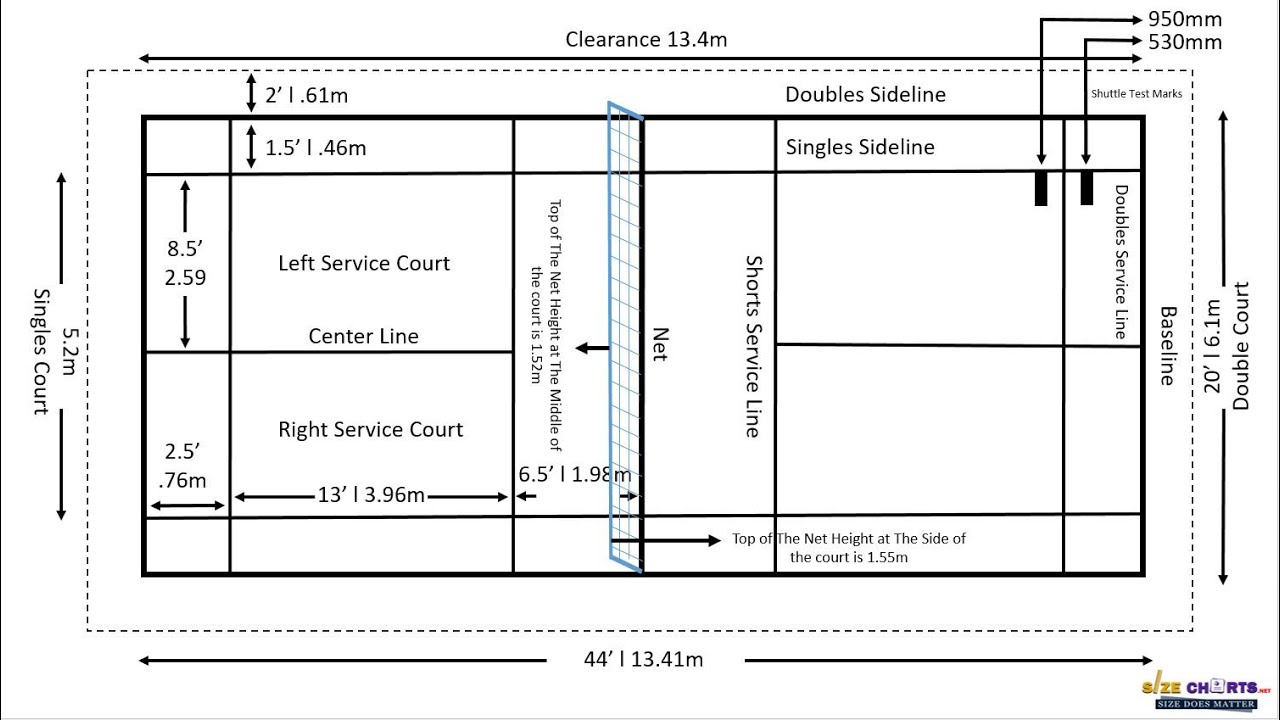
Whether you’re setting up a badminton court in your backyard, trying to understand the rules better, or just curious about the exact measurements, understanding court dimensions is essential for every badminton player.
I remember my first time playing on a regulation court. I had been playing casually in my driveway for months, and when I stepped onto a proper court, everything felt different. The lines, the space, the net height—it all mattered more than I realized.
What confused me most? The different boundaries for singles and doubles. I kept hitting shots that I thought were “in,” only to realize I was using the wrong lines. It was embarrassing, but it taught me an important lesson: knowing your court is just as important as knowing how to hit the shuttle.
In this comprehensive guide, I’ll break down every measurement, every line, and every dimension you need to know about a badminton court. Whether you’re a beginner trying to understand the basics or someone planning to build a court, this guide has you covered.
Standard Badminton Court Dimensions: The Basics
A regulation badminton court is a precisely measured rectangle. Here are the fundamental dimensions:
Overall Court Dimensions:
- Length: 13.4 meters (44 feet)
- Width: 6.1 meters (20 feet)
- Total Area: 81.74 square meters (880 square feet)
These measurements are standard worldwide and are set by the Badminton World Federation (BWF). Whether you’re playing in Tokyo, London, or New York, the court dimensions remain the same.
Important Note: These are the outer boundary dimensions. The actual playing area differs between singles and doubles matches, which we’ll cover in detail below.
Singles Court vs Doubles Court: The Key Difference
This is where most beginners get confused. The badminton court has different boundary lines for singles and doubles play.
Singles Court Dimensions:
- Length: 13.4 meters (44 feet) – same as doubles
- Width: 5.18 meters (17 feet) – narrower than doubles
- Service Court Length: 3.96 meters (13 feet)
Doubles Court Dimensions:
- Length: 13.4 meters (44 feet) – same as singles
- Width: 6.1 meters (20 feet) – wider than singles
- Service Court Length: 3.05 meters (10 feet)
The Simple Rule:
- Doubles court is WIDER but has a SHORTER service court
- Singles court is NARROWER but has a LONGER service court
Think of it this way: in doubles, you have two players covering the court, so you need more width. But the service court is shorter to prevent easy ace serves. In singles, one player covers less width, but the service court extends deeper to make serving more strategic.
Understanding the Court Lines: What Each Line Means
A badminton court has several lines, each serving a specific purpose. Let’s break them down:
1. Outer Boundary Lines (Sidelines)
Function: Define the court’s outer limits
For Doubles:
- Use the outermost sidelines
- Full width of 6.1 meters (20 feet)
For Singles:
- Use the inner sidelines
- Narrower width of 5.18 meters (17 feet)
Common Mistake: In singles, hitting the shuttle beyond the inner sideline (but within the outer sideline) is OUT. Many beginners think the outer line counts in singles—it doesn’t.
2. Back Boundary Lines (Baselines)
Function: Mark the back limit of the court
Measurement: Same for both singles and doubles – 13.4 meters from net
Important: These lines are IN. If the shuttle lands on the line, it’s considered inside the court.
3. Short Service Line
Function: Marks the front limit of the service court
Distance from Net: 1.98 meters (6.5 feet)
Rule: In both singles and doubles, the serve must land beyond this line. Landing on or before it is a fault.
4. Long Service Line (Doubles Only)
Function: Marks the back limit of the doubles service court
Distance from Back Boundary: 0.76 meters (2.5 feet) from the back line
Critical Rule: In doubles, serves must land before this line. The area between this line and the back boundary is only used during rallies, not serves.
Singles Note: Singles matches do NOT use this line for serving. In singles, you can serve all the way to the back boundary line.
5. Center Line
Function: Divides the court into left and right service courts
Length: Runs from the short service line to the back boundary line
Usage: Determines which service court you serve into (right or left)
Width: Typically 40mm (1.5 inches) wide
Net Specifications: Height and Positioning
The net is arguably the most important feature of a badminton court. Here are the exact specifications:
Net Height:
- At the Center: 1.524 meters (5 feet exactly)
- At the Posts: 1.55 meters (5 feet 1 inch)
Why the difference? The net sags slightly in the middle due to gravity and tension. This 26mm (1 inch) difference is intentional and regulated.
Net Width:
- Minimum: 6.1 meters (20 feet) – spans the full court width
- Should extend 150mm (6 inches) beyond the sidelines on each side
Net Mesh:
- Small uniform mesh
- Dark color (typically black or dark green)
- Top edge should have 75mm (3 inches) white tape
Post Position:
- Posts are positioned on the doubles sidelines
- Distance between posts: 6.1 meters (20 feet)
- Posts should be sturdy and not obstruct players
Testing Net Height: Use a measuring stick or ruler to verify the center height. Many casual courts have nets that are too high or too low, which changes the game significantly.
Service Court Dimensions: Where You Must Serve
Service courts are critical because serves must land within these specific areas. The dimensions differ between singles and doubles.
Singles Service Court
Length:
- From short service line to back boundary line
- Distance: 3.96 meters (13 feet)
Width:
- From center line to inner sideline
- Distance: 2.59 meters (8.5 feet)
Total Singles Service Box Area:
- 10.26 square meters per side
Rule: The serve must travel diagonally from one service court to the opposite service court. It must clear the short service line and land before the back boundary, staying within the singles sidelines.
Doubles Service Court
Length:
- From short service line to long service line (NOT the back boundary)
- Distance: 3.05 meters (10 feet)
Width:
- From center line to outer sideline
- Distance: 3.05 meters (10 feet)
Total Doubles Service Box Area:
- 9.3 square meters per side
Rule: The doubles serve is shorter but wider. It must clear the short service line and land before the long service line, using the full width of the court.
Key Difference: Doubles service courts are actually SMALLER in total area than singles service courts, despite the court being wider overall. This prevents easy power serves in doubles.
Court Surface and Surrounding Space
Court Surface Requirements
Material:
- Wood flooring (most common for indoor courts)
- Synthetic mats (PVC or rubber)
- Concrete (for outdoor recreational courts)
- Acrylic surface (professional outdoor courts)
Color:
- Typically green or blue for the playing surface
- White or yellow lines for visibility
- Should have minimal glare
Characteristics:
- Non-slip surface
- Some shock absorption (protects joints)
- Even and level (no bumps or dips)
- Good traction for quick movements
Required Surrounding Space
According to BWF regulations, there must be clear space around the court:
For Recreational Play:
- Sides: Minimum 1 meter (3.3 feet)
- Ends: Minimum 2 meters (6.6 feet)
For Tournament/Competitive Play:
- Sides: Minimum 2 meters (6.6 feet)
- Ends: Minimum 2.5 meters (8.2 feet)
For International Competitions:
- Sides: Minimum 3 meters (10 feet)
- Ends: Minimum 4 meters (13 feet)
Ceiling Height:
- Minimum: 9 meters (30 feet) for international competitions
- Recreational: At least 7.5 meters (25 feet)
- Lower ceilings can interfere with high clears and serves
Why Space Matters
I once played in a gym with posts too close to the court. During an intense rally, I ran back for a clear and crashed into a post. It was painful and dangerous. Adequate space isn’t just a rule—it’s a safety requirement.
Line Markings: Colors, Widths, and Standards
Proper line markings are essential for fair play and clear visibility.
Line Width:
- Standard: 40mm (1.5 inches)
- All lines should be consistent width
- Lines are part of the court (IN)
Line Color:
- Most Common: White or yellow
- Should contrast clearly with court surface
- Must be visible under court lighting
Material:
- Painted directly onto surface (permanent courts)
- Tape for temporary courts (ensure it doesn’t peel or move)
- Should be flat, not raised (prevents tripping)
Line Configuration: For courts serving both singles and doubles, you’ll see multiple lines:
- Outer sidelines (doubles)
- Inner sidelines (singles)
- Back boundary (both)
- Short service line (both)
- Long service line (doubles only)
- Center line (both)
Pro Tip: When setting up a court, use different colors for singles and doubles lines if possible. For example, white for doubles boundaries and yellow for singles boundaries. This reduces confusion during play.
Converting Measurements: Meters to Feet
For those more comfortable with imperial measurements, here’s a complete conversion chart:
Court Dimensions:
- Length: 13.4m = 44 feet
- Doubles Width: 6.1m = 20 feet
- Singles Width: 5.18m = 17 feet
Service Courts:
- Short service line from net: 1.98m = 6.5 feet
- Singles service length: 3.96m = 13 feet
- Doubles service length: 3.05m = 10 feet
- Long service line from back: 0.76m = 2.5 feet
Net Height:
- At posts: 1.55m = 5 feet 1 inch
- At center: 1.524m = 5 feet exactly
Line Width:
- 40mm = 1.57 inches (approximately 1.5 inches)
How to Measure and Mark a Badminton Court
Planning to set up your own court? Here’s a step-by-step guide:
Step 1: Gather Your Tools
You’ll Need:
- Measuring tape (at least 15 meters/50 feet)
- Chalk or marking paint
- String line
- Stakes or markers
- Carpenter’s square (for right angles)
- Helper (makes measuring much easier)
Step 2: Mark the Outer Rectangle
Process:
- Find a flat, level area
- Mark one corner as your starting point
- Measure 13.4 meters (44 feet) for the length
- Mark the opposite corner
- Measure 6.1 meters (20 feet) for width
- Complete the rectangle
- Use the 3-4-5 triangle method to ensure 90-degree corners
Checking Square Corners:
- Measure diagonal distances
- Both diagonals should be exactly 14.723 meters (48.3 feet)
- If not equal, adjust corners until they are
Step 3: Mark the Net Line
Position:
- Exactly at the center of the court
- 6.7 meters (22 feet) from each back boundary
- Should be perfectly perpendicular to sidelines
Step 4: Mark Service Lines
Short Service Line:
- 1.98 meters (6.5 feet) from the net line
- Parallel to the net
Long Service Line (Doubles):
- 0.76 meters (2.5 feet) from the back boundary
- Parallel to back boundary
Step 5: Mark Center Line
Position:
- Runs from short service line to back boundary
- Exactly at the center (3.05 meters/10 feet from each sideline)
- Perpendicular to net line
Step 6: Mark Singles Sidelines
Position:
- 0.46 meters (1.5 feet) inside the doubles sidelines
- Runs full length of court
- Final singles width: 5.18 meters (17 feet)
Step 7: Verify All Measurements
Double-Check:
- All parallel lines are truly parallel
- All perpendicular lines form 90-degree angles
- Measure diagonals of all rectangles
- Net posts positioned correctly at 6.1 meters apart
Step 8: Paint or Tape Lines
Best Practices:
- Use line width of 40mm (1.5 inches)
- Ensure lines are straight and clean
- Let paint dry completely before playing
- If using tape, press firmly to prevent peeling
Common Court Dimension Mistakes to Avoid
Mistake 1: Using Wrong Sidelines in Singles
Problem: Players use the outer (doubles) sidelines during singles play
Consequence: Shots that are actually OUT are called IN
Solution: Before starting a singles match, verbally confirm which lines are in play. The inner sidelines are the boundaries in singles.
Mistake 2: Incorrect Net Height
Problem: Net is set too high or too low
Consequence: Changes the game dynamics—high nets favor low shots, low nets favor high shots
Solution: Measure the net at center (5 feet exactly) before every match. Adjust tension to achieve proper sag.
Mistake 3: Short Service Line Too Close
Problem: Short service line marked closer than 1.98 meters
Consequence: Makes serving too easy, reduces rally length
Solution: Always measure from the center of the net line to verify correct distance.
Mistake 4: Forgetting the Long Service Line in Doubles
Problem: Not marking the doubles long service line
Consequence: Serves that should be faults are called good
Solution: Clearly mark the long service line 0.76 meters from the back boundary.
Mistake 5: Uneven Court Surface
Problem: Court has bumps, dips, or slopes
Consequence: Shuttle bounces unpredictably, increases injury risk
Solution: Check surface level before marking lines. Use a level or water test to identify problem areas.
Indoor vs Outdoor Court Considerations
Indoor Courts
Advantages:
- No wind interference
- Controlled lighting
- Consistent playing conditions
- Protected from weather
Surface:
- Typically wooden or synthetic flooring
- Better shock absorption
- Professional-grade specifications
Standards:
- Must meet exact BWF dimensions
- Proper ceiling height crucial (minimum 9 meters for competition)
- Adequate lighting without glare
Outdoor Courts
Challenges:
- Wind affects shuttle flight
- Sun glare can be problematic
- Weather-dependent play
Surface:
- Concrete or acrylic most common
- Must have proper drainage
- May be slightly rougher than indoor courts
Adaptations:
- Windbreaks or fences help reduce wind
- Proper court orientation minimizes sun glare
- Surface should be slightly textured for grip
Recreational vs Competitive: Outdoor courts are fine for casual play, but serious competition requires indoor facilities with controlled conditions.
Building a Backyard Badminton Court: Simplified Guide
Want to build a court at home? Here’s what you need to know:
Minimum Space Required
Full Court:
- Playing area: 13.4m x 6.1m (44′ x 20′)
- Including safety zones: 17.4m x 10.1m (57′ x 33′)
- Total area needed: approximately 176 square meters (1,900 square feet)
Half Court (Recreational):
- If space is limited, you can mark just half the court
- Useful for practice drills and casual play
- Not suitable for proper matches
Budget Options
Minimal Setup (Under $200):
- Temporary net system ($50-100)
- Line marking tape ($20-30)
- Basic shuttlecocks ($20)
- Measuring tape ($10)
Mid-Range Setup ($500-1,000):
- Permanent net posts and net ($150-300)
- Court paint or permanent tape ($100-200)
- Quality shuttlecocks ($50)
- Court surface preparation ($200-450)
Professional Setup ($2,000+):
- Synthetic court surface installation
- Professional-grade net system
- Proper lighting for evening play
- Surrounding fencing
- Court markings by professionals
Surface Preparation
Concrete Base:
- Pour level concrete slab
- Minimum thickness: 4 inches
- Include slight drainage slope
- Apply acrylic surface coating
- Cost: $3,000-6,000
Existing Surface:
- Clean thoroughly
- Level any uneven areas
- Paint with sport court paint
- Mark lines accurately
- Cost: $500-1,500
Court Dimensions for Different Age Groups
While regulation courts are standard, youth and recreational programs sometimes use modified dimensions:
Youth Badminton (Under 11)
Modified Dimensions:
- Length: 10 meters (33 feet) – 25% shorter
- Width: 4.5 meters (15 feet) – 26% narrower
- Net height: 1.4 meters (4.6 feet) – slightly lower
Purpose: Smaller courts help young players develop skills without being overwhelmed by space.
Junior Badminton (Ages 11-15)
Recommended:
- Transition to full-sized courts by age 13
- May use standard dimensions with lighter shuttlecocks
- Focus on proper technique over power
Adult Recreational
Flexibility:
- Can use full regulation dimensions
- Or slightly smaller for backyard courts
- Main goal is enjoyment, not strict competition
Frequently Asked Questions
Q: What is the exact size of a badminton court? A: A regulation badminton court is 13.4 meters long and 6.1 meters wide (44 feet by 20 feet) for the overall dimensions.
Q: Is the badminton court the same size for singles and doubles? A: The overall court is the same size, but the playing boundaries differ. Doubles uses the full width (6.1m), while singles uses a narrower width (5.18m).
Q: How high is a badminton net? A: The net is 1.524 meters (5 feet) at the center and 1.55 meters (5 feet 1 inch) at the posts.
Q: What is the short service line distance from the net? A: The short service line is 1.98 meters (6.5 feet) from the net in both singles and doubles.
Q: Do you use the back line for serves in doubles? A: No, in doubles you use the long service line, which is 0.76 meters (2.5 feet) in front of the back boundary. The back line is only used during rallies.
Q: Can I play badminton on any surface? A: You can play recreationally on various surfaces (grass, concrete, gym floor), but competitive play requires proper wooden or synthetic flooring.
Q: How much space do I need around a badminton court? A: For recreational play, allow at least 1-2 meters on the sides and 2 meters at the ends. Competition play requires more clearance.
Q: Are court lines considered in or out? A: Lines are IN. If any part of the shuttle touches the line, it’s considered inside the court.
Q: Why is the doubles service court shorter than singles? A: The shorter service court in doubles prevents powerful serves from being too dominant, encouraging longer rallies and more strategic play.
Q: Can I use a tennis court for badminton? A: Tennis courts are much larger (78′ x 36′) than badminton courts. You can mark a badminton court within a tennis court for practice, but the dimensions are quite different.
Badminton Court vs Other Court Sports
Understanding how badminton courts compare to other sports helps put the dimensions in perspective:
Badminton vs Tennis:
- Badminton: 13.4m x 6.1m (880 sq ft)
- Tennis: 23.77m x 10.97m (2,808 sq ft)
- Tennis court is 3.2 times larger
Badminton vs Squash:
- Badminton: 13.4m x 6.1m (880 sq ft)
- Squash: 9.75m x 6.4m (640 sq ft)
- Badminton court is 1.4 times larger
Badminton vs Pickleball:
- Badminton: 13.4m x 6.1m (880 sq ft)
- Pickleball: 13.4m x 6.1m (880 sq ft)
- Same overall dimensions! But different line markings and net heights
Badminton vs Volleyball:
- Badminton: 13.4m x 6.1m (880 sq ft)
- Volleyball: 18m x 9m (1,620 sq ft)
- Volleyball court is 1.8 times larger
International Standards and Regulations
The Badminton World Federation (BWF) sets the official standards used worldwide:
Court Dimensions: All measurements are standard globally—no variations by country or region.
Line Colors: While white is standard, the BWF allows yellow or other high-contrast colors for better visibility.
Surface Requirements: For international competitions, courts must be wooden or approved synthetic material with proper shock absorption.
Lighting Standards: Minimum 500 lux of lighting for recreational play, 750+ lux for international competitions.
Court Orientation: For televised matches, courts are oriented to optimize camera angles and player visibility.