
I walked into my badminton club for the first time, excited and ready to play. The coach handed me a shuttlecock and I immediately asked, “Why is this made of feathers? Shouldn’t it be plastic or something?”
He laughed. “Wait until you play with nylon ones. You’ll understand the difference.”
That day, I experienced both. The feather shuttlecock felt smooth, responsive, and flew beautifully. When we switched to nylon for casual practice, it felt heavy and sluggish by comparison. Yet the nylon shuttle lasted ten times longer.
For years, this confused me. Why would anyone use nylon if feather is better? Why do professionals use feather but recreational players seem to prefer nylon? There had to be more to this than just quality.
Turns out, there’s a lot more. And the answer depends entirely on what kind of player you are, where you play, and what you’re trying to achieve.
In this comprehensive guide, I’ll break down the feather vs nylon debate. You’ll understand the technical differences, the performance characteristics, the costs, and most importantly, which shuttlecock is right for you. By the end, this decision will be simple.
What Are Shuttlecocks Made Of?
Before comparing, let’s understand what we’re actually looking at.
Feather Shuttlecocks (Natural)
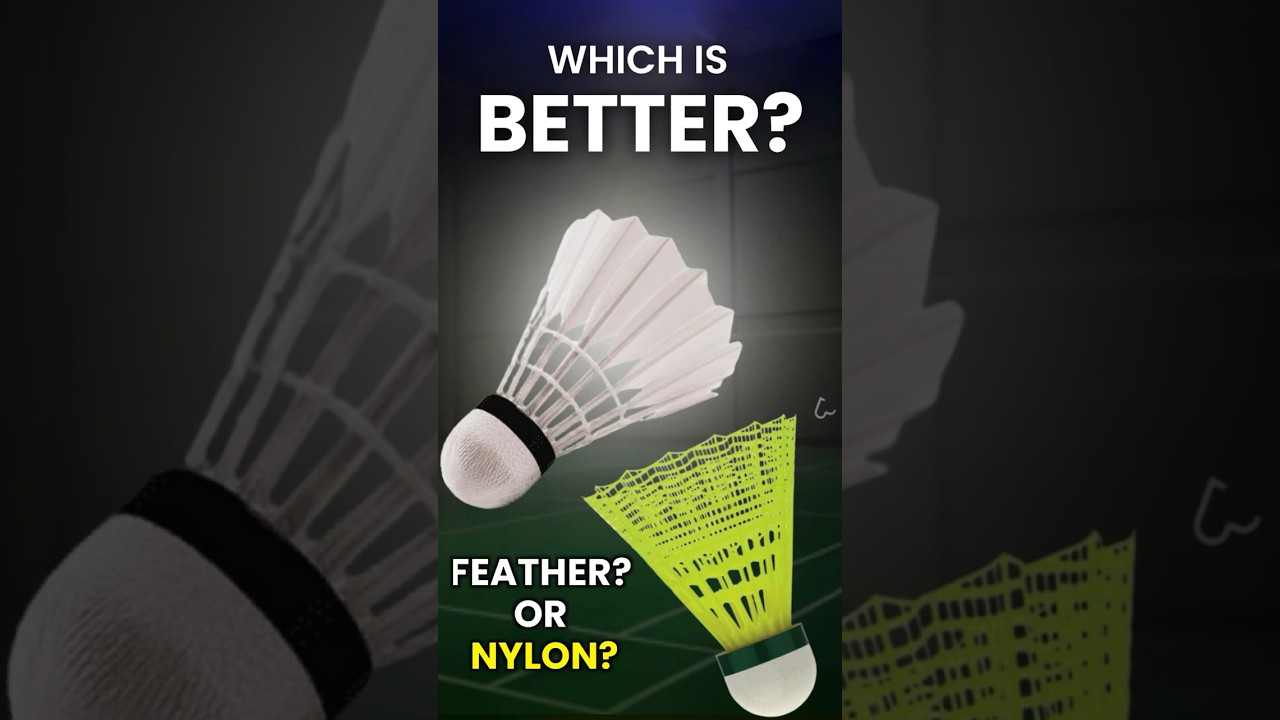
Real feather shuttlecocks contain actual feathers—typically 16 feathers from the left wing of a goose. These feathers are glued to a cork base weighing approximately 4.75-5.5 grams.
The feathers create the skirt of the shuttle. The cork provides the base and weight. The combination creates the distinctive cone shape that gives badminton its unique character.
Each feather is carefully selected and positioned. Hand-crafted feather shuttles go through rigorous quality control to ensure each one flies consistently.
Nylon Shuttlecocks (Synthetic)
Nylon shuttles have a synthetic skirt made of durable nylon material. Like feather shuttles, they have a cork base (or foam base in budget models). The nylon is pre-formed into the feather-like shape and attached to the base.
The entire construction is consistent and uniform, which allows for mass production and lower costs.
Physical Differences: What You Can See and Feel
Weight
Feather: 4.75-5.5 grams (official tournament standard is exactly 5 grams) Nylon: 4.5-5.25 grams (slightly lighter due to lighter synthetic material)
In practice, this weight difference feels minimal to most players.
Durability of the Skirt
Feather: Delicate. Feathers break, bend, or wear with use. Heavy play can damage a shuttle in minutes. Nylon: Extremely durable. The synthetic material withstands impacts and abuse that would destroy feather instantly.
This durability difference is the biggest practical distinction.
Flight Pattern
Feather: Smooth, consistent, predictable flight. The feathers create a natural deceleration curve that experienced players love. Nylon: Slightly heavier flight. Takes marginally longer to slow down. Some players describe it as “floatier.”
Feel on Contact
Feather: Crisp, responsive feel. You get immediate feedback on shuttle contact. Nylon: Slightly dampened feel. Less direct feedback but more forgiving.
Appearance
Feather: Pure white feathers with cork base. Classic, elegant look. Nylon: White synthetic material molded to look like feathers. More uniform and artificial-looking.
Performance Differences: Where It Matters
Flight Characteristics
Feather Shuttles Provide:
- Natural arc and trajectory
- Better deceleration (slows down smoothly)
- Consistent flight regardless of hit location
- Superior response to delicate shots
- Better performance in professional play
Nylon Shuttles Provide:
- Slightly flatter trajectory on some shots
- Less deceleration (maintains speed longer)
- Less consistent flight in some conditions
- More forgiving on off-center hits
- Adequate for casual and recreational play
Real Example: Hit a feather and nylon shuttle with identical technique from the same position. The feather shuttle follows a more predictable arc and stops at a consistent distance. The nylon shuttle might fly slightly differently.
Control and Precision
Feather Advantage: Experienced players have precise control with feather shuttles. You can execute delicate drop shots, place net shots exactly where you want, and execute deceptive shots with confidence.
The shuttle responds exactly as intended when you hit it properly.
Nylon Consideration: Nylon shuttles are less responsive to fine touches. Drop shots are slightly harder to control. But this also means nylon is more forgiving when you don’t hit perfectly.
Power Generation
Feather Advantage: Feather shuttles respond beautifully to power shots. A full smash with proper technique generates tremendous speed and accuracy.
Nylon Comparison: Nylon shuttles generate adequate power, but players often feel they need to work slightly harder for the same speed.
Spin Control
Feather Advantage: The natural feathers respond to spin. You can impart slice, rotation, and other advanced techniques for deception.
Nylon Limitation: Harder to apply effective spin with nylon. The synthetic material doesn’t grip or respond to spin as well as natural feathers.
Durability and Cost: The Practical Reality
This is where the discussion gets real.
Feather Shuttlecock Lifespan
Professional/Tournament Use:
- A single shuttle lasts approximately 30-45 minutes of intense match play
- After heavy play, feathers break, bend, or wear
- You can sometimes salvage a shuttle for casual practice
Recreational Play:
- Lighter use might extend life to 1-2 hours per shuttle
- Still significantly shorter than nylon
Cost Analysis:
- Premium feather shuttles (Yonex Aerosensa): $3-4 per shuttle
- Buying tubes of 12: $35-50 per tube
- Tournament use requires dozens of tubes per month
Nylon Shuttlecock Lifespan
Intensive Use:
- A nylon shuttle lasts 8-20 hours of play
- Can withstand ball-like impacts without damage
- Some shuttles last 30+ hours before wearing out
Recreational Play:
- A single nylon shuttle can last weeks or months of regular play
- Usually retire when skirt gets damaged or base breaks
Cost Analysis:
- Budget nylon shuttles: $0.75-1.50 per shuttle
- Mid-range nylon: $1.50-2.50 per shuttle
- Buying tubes of 12: $15-35 per tube
- One tube lasts many recreational players several months
Cost Comparison Example:
Professional player using feather for tournaments:
- Plays 4 matches per week
- Average match duration: 45 minutes
- Feather shuttle lifespan: 45 minutes average
- Cost: 4 shuttles per week x $3.50 = $14/week
- Monthly cost: $56
Recreational player using nylon for 3x weekly play:
- Plays 3 times per week x 2 hours = 6 hours/week
- Nylon shuttle lifespan: 10 hours average
- Uses approximately 1 shuttle every 1.5-2 weeks
- Cost: 1 shuttle every 1.5 weeks x $2 = $1.30/week
- Monthly cost: $5
The cost difference is dramatic.
When to Use Feather Shuttles
Competitive/Tournament Play
Official badminton rules require feather shuttles for:
- Official tournaments and matches
- Club competitions
- BWF-sanctioned events
- Professional play
If you’re competing officially, you must use feather shuttles. There’s no choice here.
Serious Players Developing Skills
Intermediate and advanced players training seriously benefit from feather shuttles because:
- The shuttle responds to technique refinement
- You get honest feedback on every shot
- Proper technique is rewarded, poor technique is penalized
- You learn to execute shots correctly
Dedicated Club Players
Regular club players typically use feather shuttles during practice matches and training sessions. The improved performance justifies the cost.
Players Who Value Authenticity
Some players simply prefer the authentic badminton experience. Feather shuttles feel like “real” badminton compared to nylon.
When to Use Nylon Shuttles
Casual Recreational Play
For backyard games, informal club sessions, and casual play with friends, nylon shuttles make sense:
- You’re not trying to win tournaments
- Cost savings are significant
- You play less frequently
- Durability matters more than perfect flight
Training and Drills
Nylon shuttles are excellent for solo practice and conditioning drills:
- You’re focusing on footwork, not shuttle response
- The extra durability means shuttles don’t break during intense movement
- Cost per practice session is minimal
Beginners Learning Basics
New players still learning fundamental strokes can use nylon shuttles:
- You haven’t developed technique sensitivity yet
- The more forgiving flight helps build confidence
- Cost is lower if beginners practice frequently
- Once technique develops, upgrade to feather for refinement
Indoor vs Outdoor Play
Nylon shuttles work better for outdoor play:
- Wind is less of a factor with heavier nylon
- Durability matters outside where impacts happen
- Feather shuttles can be damaged by weather and rough surfaces
Physical Education and Schools
Schools and PE programs use nylon shuttles because:
- Students are learning, not refining technique
- Durability is essential with large classes
- Cost must be kept low for budget constraints
- Many shuttles get lost or damaged
Specific Scenarios: What Should You Use?
Scenario 1: Weekly Club Player
Situation: You play at a badminton club 2-3 times per week for recreation and improvement.
Recommendation: Use feather shuttles.
Reasoning: You’re committed enough to justify the cost. Feather shuttles help your technique improve. The investment in better shuttles matches your investment in your game.
Scenario 2: Casual Backyard Player
Situation: You play badminton occasionally with family or friends for fun.
Recommendation: Use nylon shuttles.
Reasoning: You’re not competing seriously. Feather shuttles would break quickly during casual play. Nylon provides better value and still gives enjoyable play.
Scenario 3: Tournament Competitor
Situation: You compete in official tournaments regularly.
Recommendation: Use feather shuttles exclusively.
Reasoning: Official rules require feather shuttles. This is non-negotiable. Budget accordingly for shuttle costs.
Scenario 4: Beginner Taking Lessons
Situation: You’re taking structured lessons twice a week.
Recommendation: Start with nylon, transition to feather after 2-3 months.
Reasoning: While learning basics, nylon shuttles help build confidence. Once your technique develops, switch to feather for proper feedback on shots.
Scenario 5: Training and Fitness Focus
Situation: You’re doing badminton fitness training and conditioning drills.
Recommendation: Use nylon shuttles.
Reasoning: Your goal is fitness and footwork, not technique refinement. Durability matters more than shuttle response. Save money to buy feather shuttles for actual matches.
Scenario 6: Solo Practice and Skill Development
Situation: You practice alone working on specific shots and techniques.
Recommendation: Use feather shuttles.
Reasoning: Proper practice demands proper equipment. Feather shuttles provide honest feedback on your execution. The shuttle cost is justified by quality practice.
Quality Within Each Type
Not all feather shuttles are equal. Not all nylon shuttles are equal.
Feather Shuttlecock Quality Tiers:
Budget Feather:
- Price: $1.50-2.50 per shuttle
- Quality: Acceptable for casual play
- Durability: Fragile, break easily
- Consistency: Variable flight
Standard/Tournament Grade:
- Price: $3-4 per shuttle
- Quality: Official match standard
- Durability: Fragile but consistent
- Consistency: Excellent, reliable flight
- Brands: Yonex Aerosensa, Carlton, Victor
Premium Feather:
- Price: $4-5+ per shuttle
- Quality: Professional tournament standard
- Durability: Still fragile but maximum consistency
- Consistency: Perfect across all shuttles
- Brands: Yonex Aerosensa Premium, professional grade
Nylon Shuttlecock Quality Tiers:
Budget Nylon:
- Price: $0.50-1 per shuttle
- Quality: Acceptable for casual play
- Durability: Excellent
- Consistency: Variable
Standard Nylon:
- Price: $1.50-2.50 per shuttle
- Quality: Good for club use
- Durability: Very good
- Consistency: Decent
Premium Nylon:
- Price: $2.50-4 per shuttle
- Quality: Excellent for serious recreational play
- Durability: Exceptional
- Consistency: Good flight characteristics
- Brands: Yonex Nylon, Victor, Carlton brands
My Recommendation: For feather, always buy tournament-grade or premium. Budget feather shuttles are frustrating because they break quickly and fly inconsistently.
For nylon, standard grade is usually sufficient. The durability difference between standard and premium nylon isn’t huge, so the extra cost might not be worth it.
Flight Characteristics Detailed
Feather Shuttles
Aerodynamics: The 16 feathers create a natural skirt that decelerates the shuttle gracefully. Air resistance increases as speed increases, creating a smooth deceleration curve.
Behavior at Different Speeds:
- Slow shots (drop shots, net play): Shuttle falls vertically with minimal drift
- Medium shots (clears): Consistent arc with predictable distance
- Fast shots (smashes): Rapid deceleration slows the shuttle down in the opponent’s court
Wind Resistance: Feathers are affected by air currents more than nylon. This matters outdoors but is negligible indoors.
Nylon Shuttles
Aerodynamics: The molded nylon skirt is stiffer and less flexible than feathers. It creates different air resistance characteristics.
Behavior at Different Speeds:
- Slow shots: Slightly less predictable landing zone
- Medium shots: Similar to feather but with less elegant arc
- Fast shots: Maintains speed slightly longer before decelerating
Wind Resistance: Nylon shuttles are heavier and less affected by wind. Better performance in outdoor conditions.
Mixed Usage Strategy
Many serious players use both types strategically:
Tournament and Match Practice: Use feather shuttles exclusively. This is where perfect flight characteristics matter.
Conditioning and Fitness Training: Use nylon shuttles. Your goal is footwork and stamina, not technique refinement.
Casual Games and Recreation: Use nylon shuttles. Enjoy the game without worrying about shuttle costs.
Lesson and Technical Training: Use feather shuttles. Proper technique requires proper equipment.
This approach balances cost with performance optimization. You use feather shuttles when they matter most and nylon when durability and cost matter more.
Storage and Maintenance
Both shuttle types have storage requirements.
Feather Shuttles
Storage:
- Keep in sealed tubes to maintain humidity
- Store at room temperature (18-24 degrees Celsius)
- Avoid extreme heat or cold
- Keep away from moisture and humidity extremes
Lifespan Before Use:
- Properly stored feather shuttles last 1-2 years
- Humidity control is crucial; too dry and feathers become brittle
Nylon Shuttles
Storage:
- Less sensitive to humidity and temperature
- Can be stored in plastic bags
- Room temperature storage is fine
- Durability extends lifespan significantly
Lifespan Before Use:
- Properly stored nylon shuttles last 3-5+ years
- Not degrading in storage like feather
My Experience: I once stored feather shuttles in a dry basement. After 3 months, they became brittle and broke immediately during play. Now I keep them in sealed tubes and monitor humidity.
Environmental and Ethical Considerations
This is worth noting for environmentally conscious players.
Feather Shuttles
Natural Material:
- Made from goose feathers, a natural product
- Biodegradable once worn out
- Often harvested from poultry industry byproducts
Environmental Impact:
- Feathers are organic waste byproducts, so minimal additional environmental cost
- Biodegradable at end of life
- Generally considered the sustainable option
Nylon Shuttles
Synthetic Material:
- Made from plastic (nylon) compounds
- Non-biodegradable and accumulates in landfills
- Made from petroleum products
Environmental Impact:
- Synthetic materials require fossil fuel production
- Non-biodegradable waste
- Greater environmental footprint overall
For environmentally conscious players, feather shuttles are the more sustainable choice despite the higher cost. Using feather shuttles when possible aligns with environmental values.
Frequently Asked Questions
Q: Which shuttlecock is officially required for badminton? A: Feather shuttlecocks are required for all official matches under BWF rules. Nylon is only permitted for casual recreational play.
Q: Can I use nylon shuttles for official tournaments? A: No. All official badminton competitions require feather shuttles. Check with the tournament organizer to confirm the specific brand or grade required.
Q: Why do feather shuttles cost more if they break so easily? A: The cost is justified by superior performance. Feather shuttles fly more predictably and respond to technique better. For tournament and serious play, the performance benefits exceed the durability drawbacks.
Q: Should I start with nylon or feather as a beginner? A: Start with nylon shuttles while learning basics. The durability is better for beginners who lose shuttles or hit them into walls. Transition to feather after 2-3 months when your technique develops.
Q: How many feather shuttles do I need for a match? A: Professional players typically prepare 6-10 new shuttles for a match. Most matches will wear through 2-4 shuttles depending on intensity and duration.
Q: Can I mix feather and nylon shuttles in the same game? A: Technically yes, but it’s not ideal. The flight characteristics differ enough that it’s confusing to switch mid-game. For consistency, use one or the other during a session.
Q: What’s the most popular shuttle among club players? A: Yonex Aerosensa feather shuttles are the global standard for serious club play and tournaments.
Q: Why do nylon shuttles feel different? A: The synthetic material is denser and less flexible than feathers. This creates different flex characteristics and air resistance, changing how the shuttle flies.
Q: Can I use feather shuttles outdoors? A: You can, but nylon is better. Feathers are more affected by wind and weather. Outdoor play typically uses nylon unless it’s a protected environment.
Q: How do I know if a feather shuttle is damaged? A: Check for bent or broken feathers, tears in the cork base, or loose feathers. Damage typically makes the shuttle fly erratically.
Q: Should I replace feather shuttles or repair them? A: Professional-grade feather shuttles are usually too expensive to repair. Once damaged significantly, retire them and buy new ones.
Making Your Choice
Here’s the simple decision tree:
Are you competing officially? Yes → Must use feather shuttles
Are you playing casually for fun? Yes → Use nylon shuttles (better value)
Are you training seriously or taking lessons? Yes → Use feather shuttles (proper feedback on technique)
Are you doing fitness drills? Yes → Use nylon shuttles (durability matters)
Are you just learning the basics? Yes → Start with nylon, switch to feather after learning
Are you playing outdoors? Yes → Use nylon shuttles (wind resistant)
By answering these questions honestly, you’ll make the right choice for your situation.
Summary: Feather vs Nylon
Choose Feather If:
- You’re competing or training seriously
- You want authentic badminton experience
- You prioritize performance over cost
- You’ve developed solid technique
- You’re in official competition
Choose Nylon If:
- You’re playing casually for fun
- Cost is a significant factor
- Durability is important
- You’re a beginner still learning
- You’re doing fitness training
- You’re playing outdoors
The good news? You don’t have to choose forever. Many serious players use both—feather for competition and training, nylon for practice and recreation. This balanced approach gives you the best of both worlds.